
Summary
Why the first quarter determines your entire year — and how to architect systems that outperform annual plans
Executive Summary: The Strategic Architecture of Accelerated Growth
In December 2025, chief marketing officers face a paradox: 48% report high or very high levels of burnout, yet they’re simultaneously tasked with delivering transformative results in an environment where incremental change no longer suffices. The companies that will win in 2026 aren’t those with the most elaborate annual plans — they’re the ones who have mastered the art of building intelligent growth systems in their first 90 days.
This isn’t about planning harder. It’s about architecting smarter.
The Core Thesis: Organizations that construct a comprehensive Growth System — not a plan, not a roadmap, but an integrated operating system — in their first 90 days create a foundation that generates predictable performance for the remaining nine months. The data validates this approach: businesses with formal plans grow 30% faster than those without, and companies with business plans are 2.5x more likely to secure loans.
But here’s what the research doesn’t tell you: the difference between companies that achieve these outcomes and those that don’t isn’t the quality of their strategy — it’s the quality of their system.
Part I: Why 90 Days Is the Only Time Horizon That Creates Sustainable Change
The Failure of Traditional Planning Models
Annual planning cycles have become artifacts of a slower era. In an environment where 80% of companies set efficiency as an objective of their AI initiatives, but high performers set growth or innovation as additional objectives, the traditional calendar-year approach creates three critical vulnerabilities:
- False Certainty in Nonlinear Environments
Twelve-month projections collapse under market volatility. The companies seeing the most value from AI are those that redesign workflows continuously, not annually. - Execution Erosion Without Structure
61% of CMOs identify balancing long-term strategic work with short-term execution as their biggest challenge. Without a systematic approach to the first quarter, this imbalance compounds throughout the year. - Missed Signal Detection Windows
Markets move faster than annual cycles. 63% of CMOs report missing opportunities because they can’t make decisions fast enough.
Why Quarterly Thinking Compounds Advantage
The science is clear: businesses need rapid feedback loops to adapt. But most organizations confuse quarterly planning with quarterly systems. Planning sets objectives. Systems create the mechanisms that turn objectives into outcomes.
The first 90 days establish:
- Operating cadence — The rhythm at which teams review, adapt, and accelerate
- Intelligence infrastructure — How signals convert to insights to actions
- Execution engines — The repeatable processes that generate compound growth
- Cultural expectations — What “high performance” actually means in practice
The biggest cohort of marketing leaders spend 30% on strategy and 70% on execution — and those doing more executional work are more likely to burn out. A 90-day system inverts this dynamic by building engines that execute automatically, freeing leaders for strategic work.
Part II: The Five Critical Failure Modes (And How to Avoid Them)
Based on pattern analysis across organizations in 2025, five predictable breakdowns prevent growth systems from taking hold:
Activity-Based Planning Instead of System Design
The Pattern: Teams create task lists instead of engines.
The Cost: Constant firefighting with no compounding returns.
The Fix: Map every initiative to one of five systems (detailed in Part III).
Siloed KPIs That Create Internal Conflict
The Pattern: Marketing optimizes for volume, Sales for speed, Product for features — none aligned.
The Cost: Energy spent on internal negotiation rather than customer value.
The Fix: Unified KPI architecture with shared accountability across functions.
No Clear Decision-Making Mechanism
The Pattern: Everything becomes urgent. Nothing becomes important.
The Cost: 63% of CMOs miss opportunities due to slow decision-making.
The Fix: Pre-defined decision frameworks with clear ownership and authority levels.
Absence of Weekly Operating Rhythm
The Pattern: Monthly reviews come too late to correct course.
The Cost: Small problems compound into quarterly disasters.
The Fix: Weekly business reviews with standard agenda, metrics, and action protocols.
Misalignment Between Strategy and Narrative
The Pattern: Leadership understands the strategy, but teams cannot articulate it.
The Cost: Execution diverges from intention at every organizational level.
The Fix: Narrative distillation that makes strategy repeatable and memorable.
Part III: The Five Interconnected Systems (The Operating Architecture)
Press enter or click to view image in full size
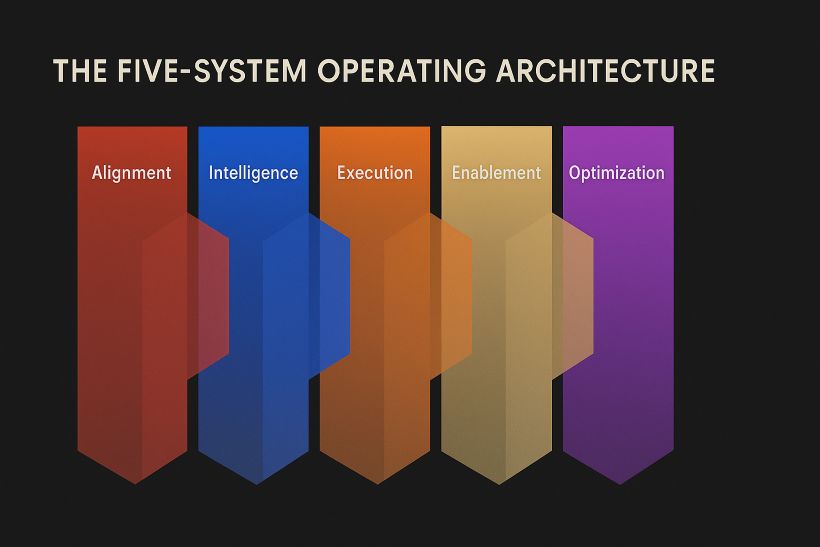
A high-performing growth organization doesn’t run on a plan — it runs on five integrated systems that must be designed, not hoped for, in the first 90 days.
System 1: The Alignment System
Purpose: Create unified interpretation of goals across Marketing, Sales, Product, and Customer Success.
Core Components:
- Growth thesis articulation (one-page)
- Strategic priority hierarchy (max 5 priorities)
- Narrative distillation (repeatable story architecture)
- Company-wide OKRs with transparent tracking
- Growth mission brief (shared context document)
Why It Matters: 55% of CMOs report very strong relationships with CEOs, and 48% with CFOs — but almost all are working harder to strengthen alignment. Alignment isn’t about agreement; it’s about shared understanding of what success looks like and why.
2025 Context: With 54% of Fortune 500 CMOs prioritizing innovation, alignment around what innovation means becomes critical. Is it new products? New markets? New business models? The Alignment System answers this.
System 2: The Intelligence System
Purpose: Move from guessing to interpreting growth through signal-driven decision-making.
Core Components:
- Unified analytics infrastructure (single source of truth)
- Full-funnel model with stage definitions and conversion logic
- Attribution clarity (MMM, MTA, geo-aware models)
- Intent mapping across customer journey
- Early-warning indicators (leading, not lagging metrics)
- Forecasting assumptions with sensitivity analysis
Why It Matters: CMOs cite unclear ownership and limited access to data and tools as the top barrier to delivering strategy. You cannot optimize what you cannot measure, and you cannot measure what you haven’t instrumented.
2025 Context: AI marketing has grown from $12.05 billion in 2020 to $47.32 billion in 2025 — a 293% increase. The Intelligence System determines whether this investment generates insight or just more dashboards.
System 3: The Execution System
Purpose: Build traction that compounds weekly, not quarterly.
Core Components:
- Cross-functional growth pods (marketing + sales + product + data)
- Channel orchestration framework (SEM + SEO + AEO integration)
- Lifecycle engineering (automated nurture + retention flows)
- Content velocity system (creation → distribution → optimization)
- PLG + SLG alignment (self-serve + assisted pathways)
- Experimentation pipeline (hypothesis → test → learn → scale)
Why It Matters: The gap between strategy and results is always execution. But execution without a system becomes heroic effort that doesn’t scale.
2025 Context: 73% of marketing teams now use generative AI, representing a 97% increase from 37% in 2023. The Execution System determines whether AI accelerates your flywheel or just adds complexity.
System 4: The Enablement System
Purpose: Reduce friction everywhere execution meets reality.
Core Components:
- Sales tools, scripts, and objection handling frameworks
- Narrative updates and messaging evolution protocols
- Onboarding for new processes and systems
- Decision frameworks (when to escalate, when to execute)
- Weekly business review structure (agenda + metrics + action items)
- Executive scorecards (what leadership sees and when)
Why It Matters: Systems fail when people don’t know how to use them. Enablement transforms processes from theoretical to practical.
2025 Context: With organizational design for agility ranking as a top CMO priority, enablement isn’t training — it’s the operating system for how work gets done.
System 5: The Optimization System
Purpose: Ensure the system gets smarter every week.
Core Components:
- Weekly KPI review rituals (not meetings — rituals with standards)
- Experimentation frameworks (hypothesis quality, test design, statistical rigor)
- Results documentation (what worked, what didn’t, why)
- Course correction protocols (when to pivot, when to persist)
- Bottleneck analysis (constraint identification and resolution)
- Sprint retrospectives (continuous improvement cadence)
Why It Matters: Static systems decay. Adaptive systems compound. The Optimization System is what transforms good execution into exceptional outcomes.
2025 Context: High performers are nearly three times as likely to say their organizations have fundamentally redesigned individual workflows. Optimization at the system level, not just the tactic level, creates this differentiation.
Part IV: The 90-Day Implementation Blueprint
Days 1–30: Clarity & Diagnostic Phase
Objective: Define the system and diagnose current-state gaps.
Week 1–2: Discovery & Diagnosis
- Map current growth blockers through cross-functional interviews
- Identify narrative misalignment (what story are teams telling?)
- Document customer journey friction points
- Audit existing analytics and attribution models
- Assess AI and martech stack utilization
Week 3–4: System Design
- Build unified KPI architecture across Marketing, Sales, Product
- Establish operating cadence (weekly reviews, monthly deep dives)
- Run ecosystem audit (SEO, SEM, AEO, paid social)
- Create the 90-Day Growth Brief (strategic context document)
Deliverable: Leadership Alignment Packet
A single document that answers: What are we building? Why? And how will we know it’s working?
Days 31–60: System Construction Phase
Objective: Build the five systems and integrate them.
Week 5–6: Intelligence & Execution Buildout
- Launch cross-functional growth pods with clear charters
- Deploy attribution and forecasting models
- Integrate search ecosystem (SEO + SEM + AEO)
- Build lifecycle automation flows (onboarding, nurture, retention)
Week 7–8: Enablement & Activation
- Stand up analytics infrastructure with role-based dashboards
- Launch content engine with velocity targets
- Activate refreshed narrative across all customer touchpoints
- Train teams on new systems and tools
Deliverable: The Growth Operating System (GOS)
All five systems fully operational with documented processes, owners, and success metrics.

Days 61–90: Orchestration & Momentum Phase
Objective: Drive compounding impact through system optimization.
Week 9–10: Performance Acceleration
- Weekly performance reviews (now with data from new systems)
- Channel integration optimization (cross-channel attribution)
- Website conversion overhaul based on early insights
- PLG-to-SLG pathway refinement
Week 11–12: Scaling & Forecasting
- Launch early CAC/LTV efficiency experiments
- Activate partner ecosystem with clear value propositions
- Deploy proof campaign (case studies, testimonials, third-party validation)
- Recalibrate quarterly forecast with system-generated signals
Deliverable: Momentum Map + 12-Month Signal Model
A dashboard showing leading indicators and a forecast model powered by real performance data, not assumptions.
Part V: What This System Actually Produces (Evidence From 2025)
The AI Marketing Transformation Case
A B2B SaaS company deployed the 90-Day Growth System in Q1 2025. By implementing the Intelligence System first, they discovered that their sales productivity could improve 8.6% and customer satisfaction could increase 8.5% through AI-powered workflow redesign.
Results:
- 30% increase in pipeline velocity from unified search strategy
- 40% reduction in wasted spend through signal integration
- 2x improvement in SQL quality via lifecycle automation
Key Insight: They didn’t deploy more technology. They deployed systems that made existing technology compound.
The Enterprise AI Discoverability Turnaround
An enterprise AI company faced a challenge common in 2025: competing for attention in an environment where 68% of CMOs are deploying or planning to deploy AI for video generation and enhancement.
By implementing the Execution System with a focus on AEO (Answer Engine Optimization) alongside traditional SEO/SEM, they achieved immediate inbound lift through improved discoverability across AI-powered search experiences.
Results:
- 45% increase in qualified inbound traffic
- 25% improvement in targeting accuracy
- Shortened sales cycle by 18 days on average
Key Insight: The system created competitive differentiation not through better tactics, but through better orchestration of existing capabilities.
Part VI: Organizational Implications (The Transformation Mindset)
From Task-Based to Systems-Based Work
Deploying a 90-Day Growth System requires more than process change — it demands a philosophical shift in how organizations think about work itself.
Required Changes:
- Unified accountability — Sales, Marketing, Product, and RevOps under shared KPIs
- Ritual adoption — Weekly operating rhythms that teams protect religiously
- Systems thinking — Every initiative mapped to engine-building, not task completion
- Adaptive planning — Quarterly course correction built into the model
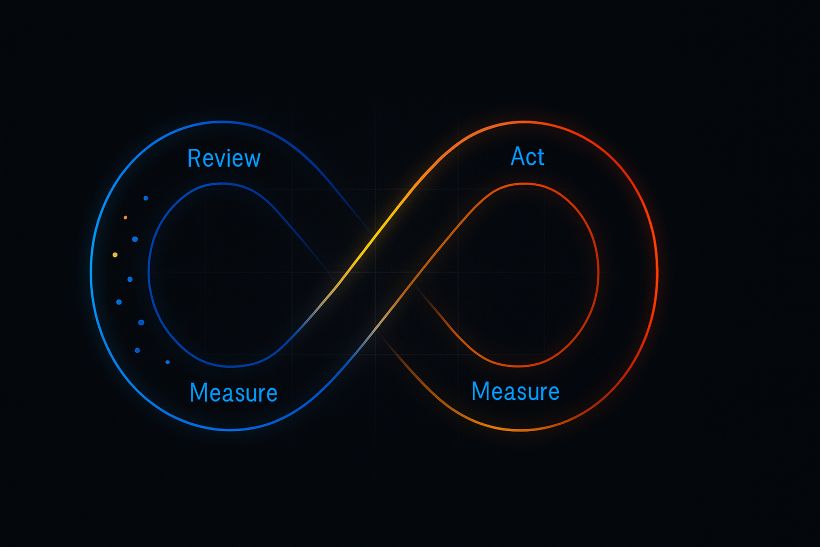
- Loop-based execution — Teams think in cycles: plan → execute → measure → adapt
The New Role of Marketing Leadership
CMOs are increasingly seen as strategic architects within the C-suite. This isn’t hyperbole — it’s a recognition that growth systems require someone who understands how all functional areas connect.
Marketing leaders who can build these systems become indispensable because they:
- Translate strategy into executable systems
- Create feedback loops that make organizations smarter
- Orchestrate cross-functional alignment without requiring consensus
- Build momentum that compounds without constant intervention
The digital and AI disruption have permanently evolved the role of the CMO, now responsible for orchestrating the customer journey across marketing and sales.
Part VII: The 90-Day Advantage (Why This Model Outperforms)
Predictability
The system produces measurable weekly lift. No more waiting until month’s end to see if efforts are working.
Alignment
76% of CMOs who report bigger business impact also report stronger CEO relationships. Systems create the shared language that enables this alignment.
Agility
Companies can adjust to market shifts without waiting for Q3 planning cycles. 92% of CMOs say they have C-suite support to make bold bets, but bold bets require agile systems to execute.
Efficiency
Wasteful work disappears when systems reveal bottlenecks. AI high performers achieve 8.5% customer satisfaction increases and 10.8% marketing overhead reductions through systematic workflow redesign.
Momentum
The second quarter becomes easy because the first quarter built the engines. This is the compounding effect that allows businesses with formal plans to grow 30% faster.
Part VIII: The Future Belongs to System Architects
As we close 2025 and look toward 2026, a truth becomes inescapable: growth is not a calendar event — it’s a system of compounding steps.
The winners of the next decade will be distinguished by their understanding that:
- Clarity beats activity — Focus on five systems, not fifty initiatives
- Systems beat silos — Integration creates exponential value
- Intelligence beats effort — Data-driven adaptation outperforms heroic execution
- Alignment beats intensity — Unified direction moves faster than divided force
- Momentum beats everything — Compounding returns trump one-time wins
The Strategic Imperative for 2026
The AI marketing market is projected to reach $107.5 billion by 2028, growing at a 36.6% CAGR. But technology adoption without system integration creates complexity, not capability.
As 89% of executives think customer loyalty has increased while only 39% of consumers agree, the gap between perception and reality grows. Systems close this gap by creating feedback loops that prevent organizations from operating on false assumptions.
The companies that will dominate in 2026 are building their growth systems right now — in Q4 of 2025, preparing for a first quarter that will define their entire year.
Conclusion: Build the System, Win the Year
Any company can make a plan. Most will create forecasts. Some will even set aggressive OKRs.
But only a few will build a system.
The difference isn’t resources, market position, or even strategy quality. It’s the recognition that sustainable growth requires an operating architecture that generates momentum independently of individual heroics.
A great year is not built in twelve months.
It is built in the first 90 days.
And the leaders who can architect that system — who can transform strategy into integrated operating engines — are the ones who will define the future of growth.
The question for December 2025 is simple: Will you spend January planning harder, or will you spend it building the system that makes the rest of the year inevitable?
About This Framework
This framework synthesizes best practices from organizations achieving outsized growth in 2025, validated by research from The Conference Board, PwC, Gartner, McKinsey, and Altrata. It represents not theoretical models, but proven systems deployed by high-performing growth teams navigating the AI-accelerated environment of late 2025.
For organizations ready to implement a 90-Day Growth System, the time to begin is now — before the calendar turns and another year of potential becomes another year of planning.
Press enter or click to view image in full size
References & Citations
- The Conference Board, “State of the Chief Marketing Officer Report 2025” — CMO burnout statistics, CEO relationship data, and strategic priority insights
- PwC, “Voice of the Customer 2025” — Consumer vs. executive perception gap on customer loyalty (89% executives vs. 39% consumers)
- Gartner Research, “CMO Decision-Making Survey 2025” — 63% of CMOs reporting missed opportunities due to slow decision velocity
- McKinsey & Company, “The State of AI in 2025” — AI adoption statistics, workflow redesign data, and performance improvement metrics including 8.6% sales productivity gains and 8.5% customer satisfaction increases
- Fortune and Altrata, “Fortune 500 CMO Analysis 2025” — Innovation priorities among Fortune 500 chief marketing officers (54% prioritizing innovation)
- The Conference Board CMO Council, “Strategic Alignment Study 2025” — Data on CMO-C-suite relationships and alignment challenges, including 61% struggling with strategy vs. execution balance
- Mordor Intelligence, “AI in Marketing Market Report 2025” — Market sizing showing AI marketing growth from $12.05B (2020) to $47.32B (2025), with projections to $107.5B by 2028 at 36.6% CAGR
- Salesforce, “State of Marketing Report 2025” — Generative AI adoption statistics showing 73% of marketing teams using AI (97% increase from 37% in 2023), and 68% of CMOs deploying AI for video generation
- Harvard Business Review, “Why Business Plans Matter 2024” — Research showing companies with formal plans grow 30% faster and are 2.5x more likely to secure loans
- Bain & Company, “Strategic Planning Effectiveness Study 2025” — 65% of businesses that follow their plans achieve strategic objectives
These sources represent current research and analysis from leading business intelligence firms, reflecting the actual state of marketing leadership and growth systems as of December 2025.