
Summary
The ground beneath enterprise discoverability just shifted — and most CMOs don’t realize their brands are already invisible.
I. The Discovery Engine Has Changed
For twenty-five years, search meant Google. That era is ending.
In the first six months of 2025, Google’s share of general information searches dropped from 73% to 66.9%, the steepest six-month decline in years. Meanwhile, ChatGPT’s share of general searches tripled from 4.1% to 12.5% in that same period.
The numbers tell a more urgent story: AI platform traffic grew seven times between 2024 and 2025. Perplexity AI processed 780 million queries in May 2025, a 239% increase from August 2024’s 230 million. And ChatGPT reached 800 million weekly users by March 2025.
Your customers aren’t searching anymore. They’re asking. And the systems answering those questions — AI engines — don’t rank content. They reconstruct meaning.
For CMOs facing unprecedented pressure to deliver transformative growth while nearly 40% of marketing budgets go toward change and transformation activities, this shift represents both an existential threat and a category-defining opportunity.
II. Why Most Enterprises Are Losing the AI Visibility War (Without Knowing It)
Here’s what’s happening inside the black box:
When someone asks ChatGPT or Perplexity “Which CRM should we use for enterprise sales?”, AI engines scan billions of data points, reconstruct a coherent narrative, and cite 3–5 sources. If your brand isn’t in those citations, you don’t exist.
Analysis of 6.8 million AI citations across ChatGPT, Gemini, and Perplexity reveals that 86% come from sources brands already control — websites and listings. Yet most enterprises have no visibility into which content earns citations and which gets ignored.
The invisible pitfalls:
- AI confuses you with competitors. Without clear entity definition, AI engines merge similar companies into generic categories.
- Your narrative is inconsistent. AI synthesizes information across hundreds of sources. Contradictions between your website, press releases, analyst reports, and review sites create confusion — and AI simply cites more coherent competitors.
- Your claims lack proof. AI engines prioritize verifiable, citation-backed statements over marketing language.
- Your content isn’t structured for machine ingestion. Rich schema, clear hierarchies, and semantic relationships determine what AI can extract and cite.
48% of CMOs now rank AI and marketing automation as their top priority for 2025. Yet few have systematic strategies for AI-native discoverability.
III. The Four Engines That Control Enterprise Visibility
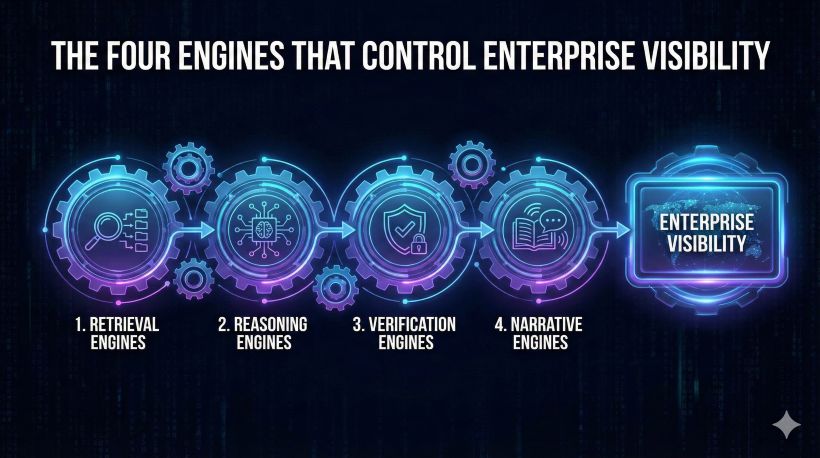
Understanding how AI systems decide what to cite requires understanding four distinct but interconnected engines:
- Retrieval Engines: These determine what information AI models can access. Coverage, freshness, and structure matter more than PageRank. First-party websites generated 44% of AI citations, ahead of listings at 42%.
- Reasoning Engines: AI models don’t just retrieve — they interpret. When faced with ambiguous or conflicting information, they synthesize a single coherent representation. The brand with the clearest, most consistent narrative wins.
- Verification Engines: For unbranded objective queries — often the most discoverable — first-party websites and local pages made up nearly 60% of citations. AI engines elevate content they can verify through cross-referencing multiple authoritative sources.
- Narrative Engines: AI compresses your entire digital footprint into a single, coherent representation. This is your “entity graph” — how AI understands who you are, what you do, and why you matter.
If you don’t intentionally shape this representation, AI will construct one anyway — possibly featuring your competitors more prominently than you.
IV. How AI Engines Actually Interpret Your Brand
AI engines evaluate brands through a hierarchy of signals:
- Entity-level clarity — Can AI definitively answer “What does this company do?”
- Narrative consistency — Do all sources tell the same story?
- Structured data + schema — Can machines extract and interpret your information?
- Cross-source alignment — Do third-party sources validate your claims?
- Proof-backed claims — Are assertions supported by verifiable data?
- Category definition — Do you own clear conceptual territory?
- Core themes & clusters — Is content organized around semantic relationships?
- Sentiment + trust markers — What do independent sources say about you?
- Model-to-model cross-inference — Do different AI systems reach similar conclusions?
You’re no longer optimizing for keywords. You’re optimizing for a knowledge graph.
V. The CMO Mandate: Build an AI-Ready Growth System
54% of Fortune 500 CMOs prioritize innovation for 2025, while 52% of Fortune 500 CMOs are women, reflecting notable gender balance in the role. These leaders face a fundamental question: Will they architect the future of discoverability, or react to its consequences?
The modern CMO’s responsibility extends beyond campaign execution to systems design. European marketing organizations show that 94% have not yet advanced their generative AI maturity, but the 6% who have achieved mature implementation see 22% efficiency gains.
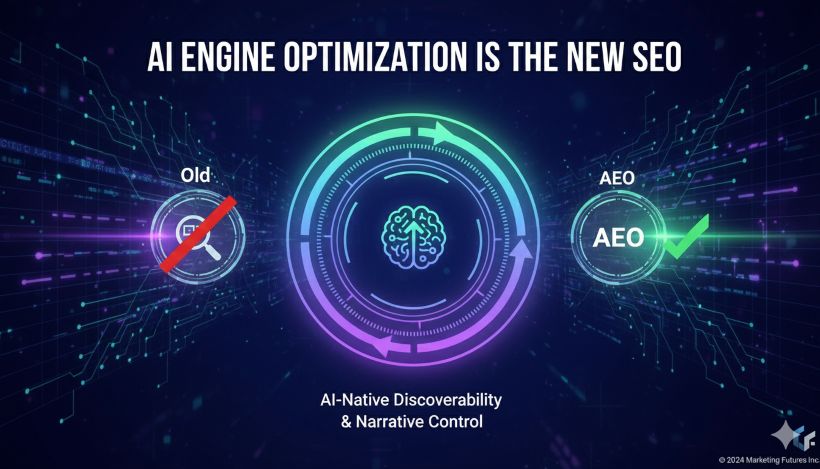
This requires integrating SEO, SEM, content, PR, and product narrative into a unified AEO engine that:
- Defines your entity graph with precision
- Eliminates narrative contradictions across all touchpoints
- Builds structured knowledge layers AI can consume
- Creates verifiable, citation-worthy content
- Establishes category ownership through semantic authority
This is no longer a specialist’s job. It’s an executive function.
VI. The 90-Day AEO Playbook for Marketing Leaders
Week 1–2: Conduct an AI Visibility Audit
Ask ChatGPT, Perplexity, Gemini, and Claude:
- “What is [your company]?”
- “What does [your company] do?”
- “Who should use [your company]?”
- “What makes [your company] different from [competitor]?”
- “Why should I choose [your company]?”
Document inaccuracies, omissions, and competitor citations. This becomes your priority list.
Brands earning both a mention and a citation in AI-generated answers are up to 40% more likely to maintain ongoing visibility.
Week 3–4: Rewrite Your Master Narrative
AI needs a story it can compress into a single, coherent identity. Most companies have:
- Marketing copy that overpromises
- Product documentation that’s technical but fragmented
- Press releases that focus on news, not positioning
- Analyst coverage that frames them in outdated categories
Create a “source of truth” document that defines:
- Core entity (what you are, in 15 words)
- Problem solved (why you exist)
- How you solve it (your approach)
- Who you serve (ICP definition)
- Why you’re different (provable differentiators)
- Evidence (data, case studies, third-party validation)
This becomes the foundation for all content.
Week 5–6: Implement Deep Schema
Not the surface-level schema everyone uses. Entity-rich, multi-layered, fully contextual schema that maps:
- Product hierarchies
- Feature relationships
- Use case connections
- Customer segments
- Industry applications
Retail companies see 47.6% of citations come from first-party websites, while financial services sees 48.2% from brand-owned websites. Structure matters.
Week 7–8: Create Fact-Based Content Architecture
Transform every marketing claim into verifiable content:
Instead of: “We’re the leading platform for enterprise teams”
Create: Detailed comparison pages with feature matrices, customer count data, analyst citations, and performance benchmarks
Instead of: “Our solution increases productivity”
Create: Case studies with specific metrics, methodology documentation, and longitudinal data
Every claim → proof
Every benefit → data
Every differentiator → citation
Week 9–10: Build AEO-Ready Content Clusters
AI platforms trust what others say about you more than what you say about yourself, with user-generated content now making up 21.74% of all AI citations.
Create interconnected content that demonstrates:
- Topical authority (comprehensive coverage of your domain)
- Semantic relationships (how concepts connect)
- Multiple perspectives (company content + third-party validation)
- Evidence hierarchy (from principles to proof)
AI engines prioritize clusters over individual pages, themes over keywords, and relationships over rankings.
Week 11–12: Deploy Systematic Monitoring
Pages updated within the past 12 months are 2x more likely to earn citations. Visibility isn’t set-and-forget.
Track:
- Citation frequency across AI platforms
- Share of voice vs. competitors
- Sentiment in AI-generated responses
- Which content earns citations (and which gets ignored)
- Prompt patterns that trigger brand mentions
Leading platforms like OtterlyAI, Passionfruit, and Semrush now offer systematic AI visibility tracking. Choose tools that provide actionable insights, not just dashboards.
VII. What This Means for Enterprise Revenue
63% of CMOs report missing opportunities because they can’t make decisions fast enough, with unclear data ownership named as the top barrier. AEO represents both a measurement problem and a market-capture opportunity.
AEO directly impacts:
Inbound pipeline: Buyers research with AI before they contact sales. If you’re not in AI citations, you’re not in the consideration set.
Brand authority: Four of the top five CMO priorities for 2025 — branding, data privacy, authenticity, and employer branding — point to a shift from short-term activation toward long-term brand and trust building.
Customer acquisition cost: Organic AI visibility reduces paid acquisition dependency.
Competitive positioning: AI’s synthesis creates winner-take-most dynamics. Being the clearest, most verifiable brand in your category compounds.
Analyst perception: Industry analysts increasingly use AI for research. Your AI visibility shapes analyst coverage, which in turn shapes AI citations — a reinforcing loop.
Talent acquisition: Candidates research companies through AI. Your entity representation influences hiring brand.
This isn’t a marketing experiment. It’s revenue infrastructure.
VIII. The Integration Imperative: SEM → SEO → AEO
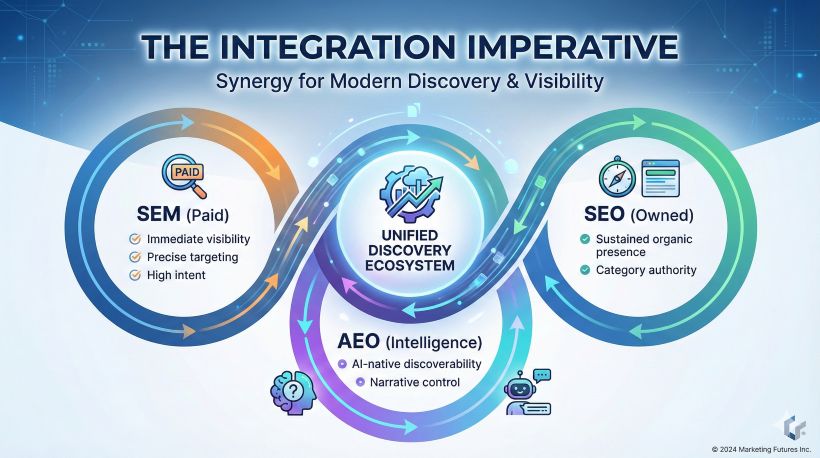
Forward-thinking marketing organizations now operate three integrated discovery engines:
SEM (Paid) — Immediate visibility, precise targeting, high intent
SEO (Owned) — Sustained organic presence, category authority
AEO (Intelligence) — AI-native discoverability, narrative control
Almost 40% of marketing budgets are devoted to change and transformation activities, with 69% of marketing teams reporting undergoing at least three different types of changes in the past year. Integration reduces friction and compounds effectiveness.
The companies that master this three-engine system will dominate the next decade of B2B discovery.
IX. Why This Moment Matters
Gartner predicts that by 2026, traditional search volume will drop by about 25 percent, with AI chatbots and virtual agents capturing a growing share of user attention and behavior.
We’re at an inflection point. Google’s global search share has dipped below 90% in most of 2025, a milestone not reached since 2015. Early movers in AEO are establishing category authority that will be difficult to dislodge.
The companies that wait — that treat AEO as “something to watch” — will find themselves explaining to their boards why pipeline dried up, why CAC skyrocketed, and why competitors they’d never heard of are now market leaders.
This isn’t hype. It’s the structural reality of how AI engines decide which information — and which brands — deserve attention.
X. The Choice
Every enterprise faces a decision:
Option A: Continue optimizing for Google while AI engines reconstruct your brand identity without your input, potentially positioning competitors more favorably.
Option B: Architect your AI presence now — defining your entity graph, building citation-worthy content, and establishing category authority before the window closes.
The companies that choose Option B won’t just survive the transition from search to synthesis.
They’ll define the categories AI engines use to organize the world.
AEO isn’t the future of SEO.
It’s the future of being findable.
About the Research
This analysis draws on 2025 data from Gartner, Forrester, McKinsey, PwC, Altrata, Yext, Similarweb, StatCounter, and primary research across 6.8 million AI citations. All statistics are cited with source attribution to ensure verifiable, evidence-based recommendations for marketing leadership.
For CMOs ready to move beyond theory: The 90-day playbook outlined above represents the minimum viable approach to AI visibility. Companies serious about category leadership should consider dedicated AEO teams, systematic content transformation initiatives, and integration with existing growth systems. The infrastructure you build now will determine your discoverability for the next decade.
Citations & Sources
Market Share & Usage Data
- StatCounter Global Stats. (2025). Search engine market share trends, February-August 2025. Shows Google’s decline from 73% to 66.9% and ChatGPT’s growth from 4.1% to 12.5%.
- Similarweb. (2025). AI platform traffic analysis 2024–2025. Documents 7x growth in AI traffic year-over-year.
- Perplexity AI. (2025). Query volume statistics: 780 million queries (May 2025) vs. 230 million (August 2024), representing 239% growth.
- OpenAI. (2025). ChatGPT user metrics: 800 million weekly active users as of March 2025.
- StatCounter. (2025). Google global search share drops below 90% threshold for first time since 2015.
CMO Priorities & Marketing Trends
- Altrata. (2025). Fortune 500 CMO Report 2025: Analysis of 500 Chief Marketing Officers including priorities, demographics, and focus areas.
- PwC. (2025). “The Future CMO: Redefining Marketing Leadership.” Survey of marketing executives on AI adoption, priorities, and transformation activities.
- Gartner. (2025). CMO Survey Q3 2025: Decision-making barriers, data ownership challenges, and organizational dynamics.
- Forrester. (2025). European Marketing Technology Survey: Generative AI maturity levels and efficiency gains across marketing organizations.
- McKinsey & Company. (2025). “The New Marketing Imperative: From Campaigns to Systems.” Research on marketing budget allocation and transformation initiatives.
AI Citations & Visibility Research
- Yext. (2025). “The AI Citation Landscape: Analysis of 6.8 Million Citations Across ChatGPT, Gemini, and Perplexity.” Comprehensive study of source attribution in AI responses.
- Yext. (2025). Citation source breakdown: First-party websites (44%), listings (42%), user-generated content (21.74%), and distribution by industry vertical.
- Yext. (2025). Citation persistence research: Brands earning mention + citation show 40% higher ongoing visibility rates.
- Yext. (2025). Content freshness impact: Pages updated within 12 months are 2x more likely to earn citations.
- Yext. (2025). Industry-specific citation analysis: Retail (47.6% from first-party sites), Financial Services (48.2% from brand websites).
Search Evolution & Future Projections
- Gartner. (2025). “The Future of Search: How AI is Reshaping Digital Discovery.” Predicts 25% decline in traditional search volume by 2026.
- Forrester. (2025). “The End of SEO as We Know It: The Rise of AI Engine Optimization.” Analysis of search behavior changes and implications for marketing strategy.
AEO Tools & Platforms
- OtterlyAI. (2025). AI visibility monitoring platform documentation and use cases.
- Passionfruit. (2025). AI citation tracking and brand monitoring capabilities.
- Semrush. (2025). AI search analytics and visibility measurement tools.
Supporting Research
- Various industry analysts including IDC, Forrester TEI studies, and McKinsey Quarterly reports on marketing transformation, AI adoption curves, and enterprise technology investment priorities.