Summary
You can’t scale what you don’t understand.
And if you can’t name the exact belief shift you cause in your customers, you’re not ready to grow. You’re ready to guess.
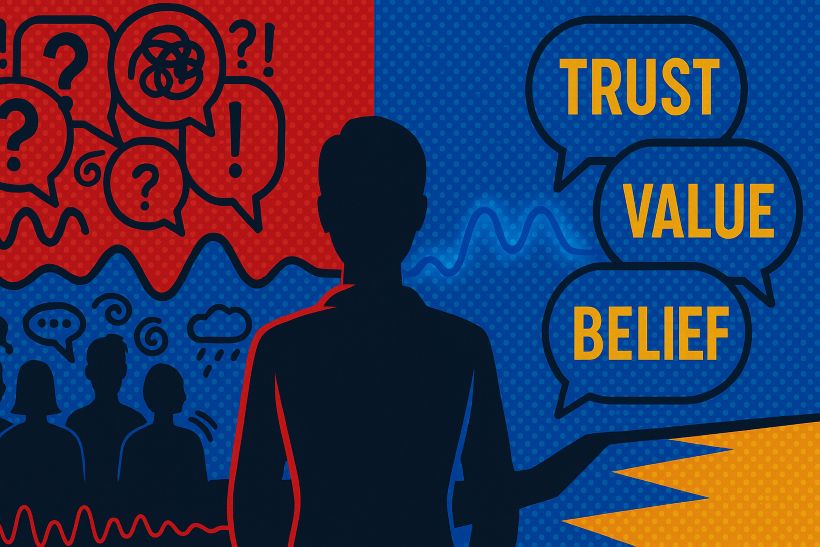
I’ve watched this pattern destroy growth trajectories over and over: A company finds early traction. They land customers, get wins, build momentum. Leadership says “Great, now scale it.” So they do the logical thing — more ad spend, more content, more sales reps, more campaigns.
But growth doesn’t scale linearly. Sometimes it stalls completely.
The diagnosis is always the same: “We need better execution. More budget. Better talent.”
But that’s not the real problem. The real problem is they never understood what was working in the first place. They couldn’t name the exact belief shift that turned skeptics into customers. So when they tried to scale, they just scaled activity — not the thing that actually converted.
That’s the paradox. You can’t scale what you don’t understand.
Today, I’m breaking down the framework that changes everything: the belief shift. What it is, why most companies miss it completely, and how to engineer it so you can actually scale.
Business Is Belief Transfer
Let me start with the principle that rewrites everything you think you know about growth:
At the core, business is belief transfer.
You’re not selling products. You’re not selling services. You’re shifting what people believe.
Every conversion — every sale, every closed deal, every committed team member — is a belief shift.
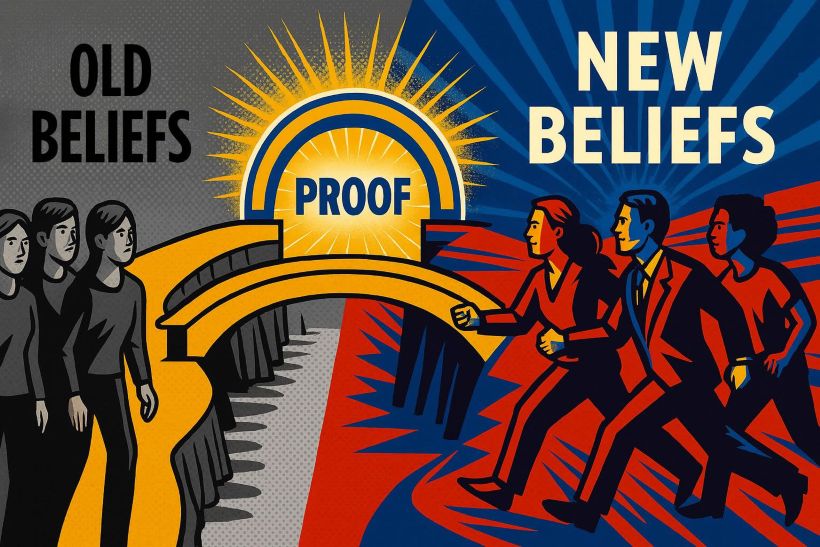
What Belief Shifts Actually Look Like
In customers:
- From “I don’t think this will work for me” → To “This is exactly what I need”
- From “I don’t trust this vendor” → To “I trust them more than anyone else”
- From “This problem isn’t urgent” → To “I can’t afford not to fix this now”
In teams:
- From “This will never work” → To “We can actually pull this off”
- From “I’m burned out” → To “This system keeps me sharp”
- From “My work doesn’t matter” → To “What I do moves the needle”
In markets:
- From “This category is saturated” → To “There’s room for someone doing it differently”
- From “AI is hype” → To “AI is strategic infrastructure”
- From “Email is dead” → To “Email is evolving and still essential”
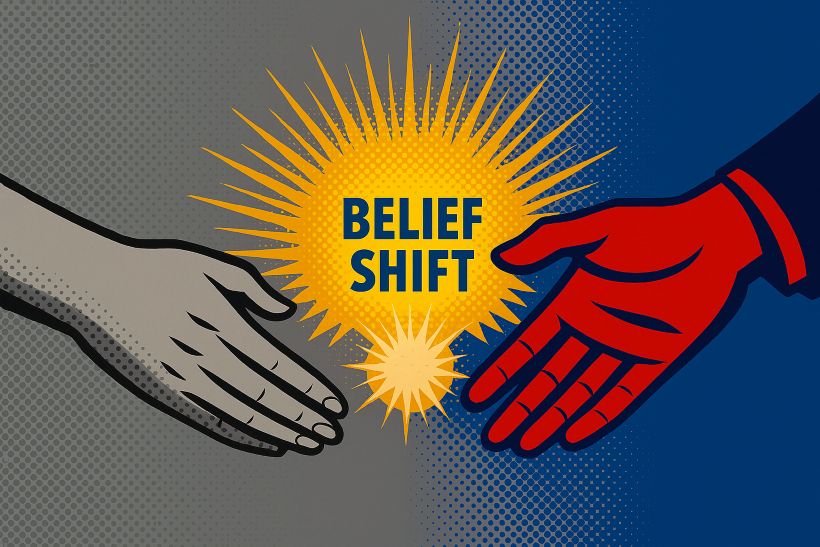
Here’s the insight that changes everything: That moment — the shift from old belief to new belief — that’s your real product.
The software? The service? The strategy? Those are delivery mechanisms. But what you’re actually selling is the shift.
And if you can’t define that shift precisely, you can’t replicate it. Which means you can’t scale it.
Why Most Companies Scale Noise, Not Clarity
Here’s the failure mode I see constantly:
A company gets early traction. They close some deals. They think “Great, let’s do more of everything.”
So they scale:
- Content volume (from 2 posts a week to 10)
- Ad spend (from $10K/month to $100K/month)
- Headcount (from 3 people to 15)
- Channels (from email to email + social + paid + events + partnerships)
But conversion rates don’t scale. Sometimes they drop.
Leadership is confused: “We’re doing 5x the activity. Why isn’t growth 5x?”
Because they scaled the inputs without understanding the conversion mechanism.
They never asked: “What exact belief shift causes someone to buy? And how do we engineer that shift repeatedly?”
They just assumed: “More activity = more results.”
But that’s not how belief works.
The Conversion Moment Most Leaders Miss
A SaaS company lands 10 customers. They’re excited. But when you ask “Why did those 10 buy?” they say: “Great sales calls. Good timing. They really needed our solution.”
That’s not an answer. That’s guessing.
Now ask: “What did those 10 believe before they met you? And what shifted during the sales process that made them buy?”
If they can’t answer that with precision, they can’t replicate it at scale.
But if they can say:
“Before us, they believed their current process was ‘good enough’ — painful, but manageable. During the sales process, we showed them the hidden costs of ‘good enough’ — the time waste, the error rate, the team friction. The shift happened when they realized: ‘good enough’ is costing us more than fixing it would. Once that belief shifted, closing was easy.”
Now they can engineer that shift intentionally:
- Content that exposes hidden costs
- Case studies that quantify “good enough” vs. optimized
- Frameworks that help prospects self-diagnose
They’re not scaling noise. They’re scaling the conditions that create the belief shift.
That’s how you grow predictably.
The Three Questions That Change Everything
Belief shift clarity isn’t tactics. It’s strategy. Because strategy is “here’s how we win” — and you can’t win if you don’t know what conversion actually requires.
To understand your growth engine, ask three ruthless questions:
Question 1: Before us, what did customers believe?
Not “what was their problem?” But “what did they believe about that problem?”
Examples:
- “AI is hype; it can’t actually drive revenue”
- “Email is dead; we need to be on newer channels”
- “We don’t need systems; we’re too small”
- “Marketing can’t prove ROI; it’s just a necessary expense”
That’s the starting belief. The one you need to shift.
Question 2: After us, what do they believe?
What’s the new belief that makes buying obvious?
Examples:
- “AI is a competitive edge if it’s applied with clarity”
- “Email is evolving and still our highest-ROI channel”
- “Systems are what let small teams punch above their weight”
- “Marketing can and should prove ROI — here’s how”
That’s the destination belief. The one that precedes the sale.
Question 3: What proof do we give them to cross that bridge?
How do we move them from old belief to new belief?
Examples:
- Case studies showing AI-driven revenue impact
- Data comparing email ROI to other channels
- Frameworks showing system ROI for small teams
- Attribution models proving marketing’s revenue contribution
That’s your conversion mechanism. The bridge between beliefs.
When You Can Answer All Three
Everything clarifies:
Your messaging writes itself. It addresses the old belief and proves the new one.
Your content strategy becomes obvious. Create proof that builds the bridge.
Your sales process gets efficient. You’re not convincing, you’re confirming a belief shift that already happened.
Your hiring becomes clearer. You need people who understand this belief shift and can engineer it.
That’s strategy. Not “let’s try this channel” or “let’s test this campaign.” But “here’s the belief we shift, here’s how we shift it, here’s how we scale that shift.”
Why This Matters
Belief shift clarity isn’t just about scaling the business. It’s about understanding growth at a strategic level.
What Boards Actually Care About
Boards don’t care about impressions, clicks, or follower counts. They care about one thing: Can you reliably turn skepticism into trust, and doubt into buy-in?
Here’s the difference in how you present:
Tactical operator: “We ran 15 campaigns this quarter and generated 5,000 leads.”
Strategic leader: “We identified that our target customers believed our category was too complex to implement. We engineered a belief shift through simplified frameworks and proof-of-concept case studies. Conversion rate improved from 8% to 19%. Now we’re scaling that playbook across three new segments.”
One reports activity. The other demonstrates strategic understanding.
One gets nods. The other gets promoted.
The Part Nobody Talks About: Internal Belief Shifts
Here’s the critical piece most leaders miss: Belief shifts aren’t just for customers. Your team needs belief shifts too.
Think about the belief shifts high-performing teams have:
- From “This will never work” → To “We can actually pull this off”
- From “I’m burned out and nothing will change” → To “This system keeps me sharp without destroying me”
- From “My work doesn’t matter” → To “What I do moves the needle”
- From “Leadership doesn’t get it” → To “Leadership sees us and has our back”
Those shifts separate teams that execute from teams that drag.
And just like customer belief shifts, you can engineer these:
Proof for “We can pull this off”: Early wins, quick feedback loops, visible progress
Proof for “System keeps me sharp”: Protected time, clear priorities, sustainable pace
Proof for “My work matters”: Direct line from their work to business outcomes, recognition when it happens
Proof for “Leadership has our back”: Consistent follow-through, transparent communication, protection from chaos
Leaders who understand this don’t just manage tasks. They engineer belief. And teams with strong belief execute faster, innovate more, and stay longer.
That’s not soft skills. That’s infrastructure.
How to Discover Your Belief Shift (If You Don’t Know It Yet)
Here’s the practical process:
Step 1: Interview Recent Converts
Talk to your last 10 customers who bought. Not a survey. Actual conversations.
Ask:
- “Before you found us, what did you believe about [problem/category]?”
- “What changed during our sales process that made you decide to buy?”
- “If you had to explain to a peer why you chose us, what would you say?”
Listen for the belief language. Not just “we needed X” but “I used to think Y, now I believe Z.”
Step 2: Analyze Lost Deals
Talk to people who didn’t buy. This is where you learn what belief shift you failed to create.
Ask:
- “What held you back from moving forward?”
- “What would need to be true for you to feel confident buying?”
- “What did we not prove that you needed to see?”
That gap? That’s where your belief shift mechanism is breaking.
Step 3: Map the Before/After
Now synthesize:
Before belief: [What they believed before encountering you]
After belief: [What they need to believe to buy]
Bridge: [What proof/experience creates that shift]
Write it down. One paragraph. Clear and specific.
That’s your belief shift map. That’s your growth engine blueprint.
Why Most Companies Can’t Name Their Belief Shift
Here’s why this is so hard for most teams:
They focus on features, benefits, outcomes. “We help you save time.” “We increase efficiency.” “We drive revenue.”
But those aren’t belief shifts. Those are results of belief shifts.
The actual shift is deeper:
Not “We save you time” but “You believe that getting time back is actually possible — and that we’re the ones who can deliver it.”
Not “We increase efficiency” but “You believe your current process is broken and that there’s a better way that won’t disrupt everything.”
Not “We drive revenue” but “You believe that revenue growth isn’t about working harder, it’s about working differently — and you trust us to show you how.”
That’s harder to articulate. It requires understanding psychology, not just positioning.
But it’s the difference between companies that scale predictably and companies that chase growth through volume.
Your Action Step
Write down, in one sentence, the before-and-after belief shift you create for your customer.
Template:
“Before us, customers believed [old belief]. After working with us, they believe [new belief]. We create that shift by [proof/bridge].”
If you can’t complete that sentence with precision, you’re not ready to scale yet. You’re still in discovery.
Once you can complete it, make sure every message, every proof point, every campaign reinforces that shift.
That’s your growth engine. That’s what scales.
The Bottom Line
You can’t scale what you don’t understand.
Until you can name the belief shift you cause — with precision, with confidence, with proof — you’re not ready to grow. You’re ready to guess.
And guessing doesn’t compound.
Most companies are running on guesses disguised as strategy. They’re scaling activity, not conversion mechanisms. They’re measuring everything except the one thing that matters: what belief changes when someone decides to buy.
The companies that break through aren’t louder. They’re clearer. They know exactly what belief they shift, how they shift it, and what proof makes that shift inevitable.
That clarity becomes their moat. Their scaling playbook. Their competitive advantage.
So do the work. Discover the shift. Engineer the bridge. Build the proof.
That’s how you move from random traction to repeatable growth. That’s how you stop burning budget on “more” and start investing in what actually converts.
That’s how you scale.