
Summary
Somewhere between product demos and board decks, innovation loses its meaning.
The engineers know exactly what they’ve built.
The market has no idea why it matters.
That’s the translation gap; the invisible wall between technical brilliance and market belief. Every AI and SaaS company hits it eventually. It’s the moment when your tech works flawlessly but your story doesn’t. When the code is elegant, but the conviction never ships.
Innovation doesn’t fail because the product doesn’t work; it fails because belief wasn’t shipped with it.
The Hardest Thing to Sell Is the Obvious
Inside the company, everything makes sense. The product vision, the architecture, the model. You’ve spent months, maybe years, thinking about what it does and how it’s built.
Outside the company, none of that matters.
The customer doesn’t think in frameworks or feature sets. They think in consequences: does this make me faster, smarter, safer, richer, calmer? And when your message leads with how instead of why, you’re asking the market to do the translation work for you. They won’t.
That’s the silent drag on growth that no dashboard captures. It’s not bad code or weak demand gen. It’s cognitive friction; the energy it takes for someone to make sense of what you’re offering. Every layer of confusion is a tax on adoption. The bigger the brilliance, the higher the tax.

Where Translation Breaks Down
I’ve seen this play out in every kind of company: AI startups, developer platforms, enterprise SaaS. The story is always the same:
Engineering speaks precision.
Marketing speaks persuasion.
Sales speaks outcomes.
Leadership speaks vision.
And somewhere between those languages, belief gets lost in translation.
- Product launches get delayed because no one can agree on how to explain it.
- Go-to-market decks swing between too technical and too fluffy.
- Messaging docs get rewritten so many times they lose their heartbeat.
- Teams burn out because they’re building and rebuilding the same bridge from different ends.
The result? A brilliant product that feels invisible.
The irony is that the harder the problem you solve, the harder it is to describe — and the more you need that translation layer built in from day one.

The Real Work of the Translation Layer
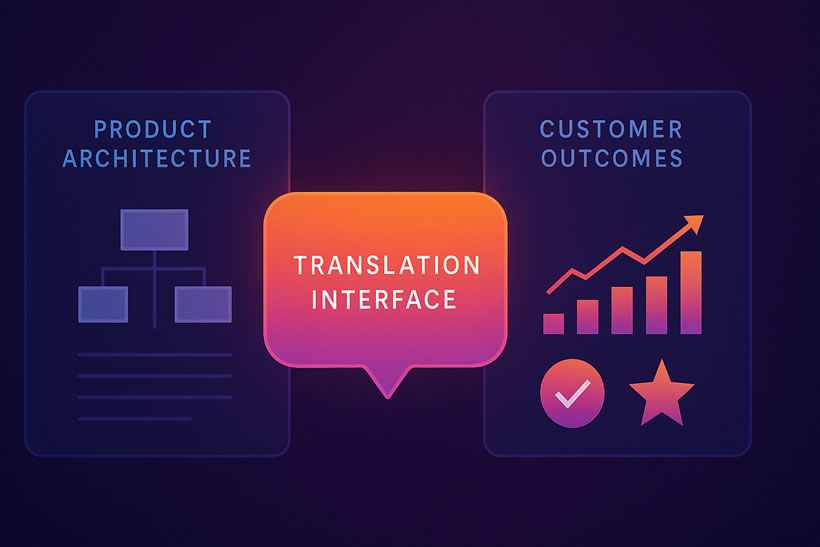
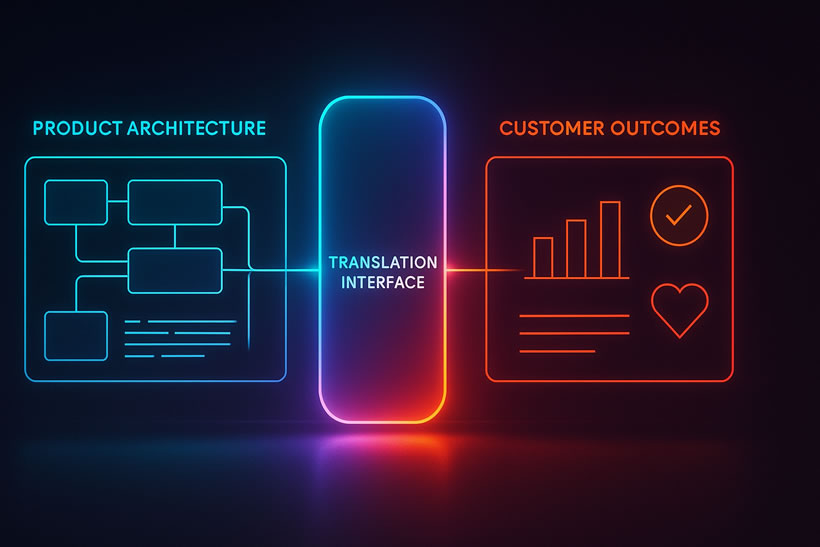
The best growth leaders I know operate like API translators between engineering and emotion. They don’t simplify brilliance, they contextualize it. They know that clarity isn’t the enemy of complexity. It’s the delivery system for it.
They ask the right questions:
- What problem are we actually solving?
- What does that feel like for the person living it?
- How do we describe the outcome without dumbing down the truth?
Then they build the infrastructure to make that translation automatic.
Product marketing becomes a system, not a department. It sits between engineering, GTM, and leadership as a live interface, syncing context, language, and proof in real time.
The best companies don’t leave translation to “the launch team.” They design it as part of the product pipeline. Every feature ships with its own story architecture. Every demo maps to an emotion, not just a function. Every internal doc explains not just what changed, but why it matters to the market.
That’s how belief scales.
The Cost of Poor Translation
Most companies underestimate the cost of unclear language.
Confused buyers delay decisions. Confused investors doubt traction. Confused teams duplicate effort. Confused markets commoditize you.
It shows up everywhere, in slow adoption curves, misaligned sales cycles, mismatched expectations, and teams that sound like they work for different companies.
Clarity isn’t cosmetic. It’s economic. When your translation layer is weak, your growth engine burns fuel instead of compounding.
When the Market Finally Understands You
There’s a moment in every company’s life when it finally clicks. The product hasn’t changed, but the story has and suddenly the world starts explaining your value back to you. That’s when translation turns into traction.
I’ll never forget the first time I watched an AI platform explain itself to a customer without mentioning the model. No jargon, no “powered by,” no half-hour whiteboard session on architecture. Just a clean articulation of value: “We help your team act faster on data they already have.”
Simple. True. Believable.
That’s what it sounds like when the belief ships with the product.
Building the Loop
Translation isn’t a one-time project. It’s a feedback loop.
You test the language like you test the product.
You monitor what resonates.
You refactor when the story drifts.
You treat the message like code, with version history, dependencies, and documentation. Because every market learns at its own pace, and the language has to evolve as understanding deepens. If you want sustained growth, the translation layer has to scale alongside the product.

The Takeaway
Engineering builds the future. Marketing makes the rest of the world believe in it. Between the two is a fragile bridge: part data, part empathy, part storytelling. The companies that cross it don’t just win markets. They redefine them.
So before you spend another quarter optimizing your funnel, ask a harder question:
Does the market actually understand what makes you remarkable?
Because brilliance doesn’t scale on its own. It needs a translator. It needs belief built in. It needs language that can carry the weight of what you’ve made.
That’s the translation layer and that’s where growth actually happens.